

Graphene has been discussed as a wonder material that will unlock the next-generation technologies seen in sci-fi movies. This article explores why these advances have not been seen, the tangible success that graphene has shown in consumer electronics and a look to the potential role of graphene in the next iteration of batteries.
Graphene was initially celebrated as a sci-fi material destined to transform electronics, quantum devices, and futuristic sensors. While expectations soared, commercial reality proved more modest. Rather than enabling transparent phones or levitating trains, graphene first succeeded in practical roles such as enhancing polymer composites in tires, coatings, and sporting goods through improved strength and conductivity. Now, with advances in manufacturing and renewed interest from major electronics and energy companies, the question resurfaces: are we finally approaching the breakthrough era once promised?
IDTechEx has covered the graphene market since 2012, providing a unique perspective on technological progress, commercialization strategies, and the long-term market outlook for the material. A new report has been released, "Graphene & 2D Materials 2026-2036: Technologies, Markets, Players", which includes granular 10-year graphene market forecasts, based on profiles of 90+ key players and leverages extensive in-depth coverage of many end-use markets for graphene.
Graphene is increasingly used in consumer electronics for thermal management, leveraging its exceptional heat conductivity to improve device cooling and reliability. Beyond passive materials, its high surface area and conductivity also make it a strong candidate for energy storage applications, particularly in next-generation batteries and supercapacitors, where faster charging and longer lifetimes are sought.
Material Requirements
Pristine graphene produced via chemical vapor deposition (CVD) offers exceptional electronic performance but is costly and complex to scale. As a result, it's primarily reserved for high-end sensing applications. Most other uses such as thermal management films or battery additives can rely on lower-grade, bulk graphene materials without requiring perfect atomic structure.
IDTechEx believes that thermal management applications is a key early area for graphene adoption. There is increasing demand for high-performance heat spreaders, and the graphene properties and morphology are well-suited. The thermal conductivity of carbon materials tend to be higher than that seen in metals, with graphene oxide (GO) reporting a thermal conductivity in excess of 3,000 W/mK. For anisotropic materials such as graphene, achieving through-plane alignment is key for a thermally efficient system, capable of minimising material usage and enabling cost savings. Multiple routes exist based on the material to be aligned, including mechanical methods and dielectrophoresis. This need for alignment to enhance thermal conductivity is mirrored in applications leveraging the electrical conductivity of graphene, such as when using graphene dispersions as conductive inks.
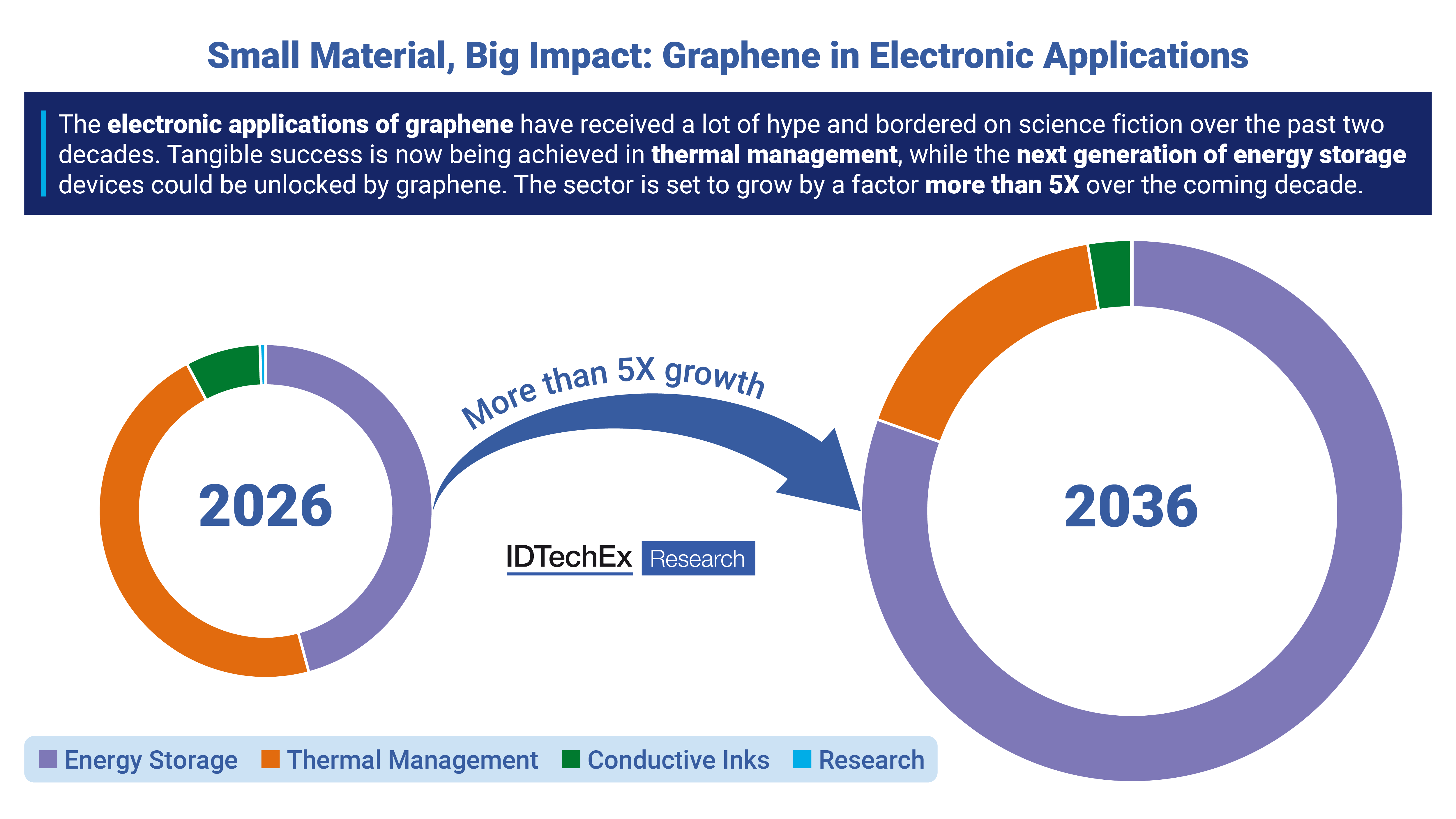
Overview of the growing importance of graphene in electronic applications over the coming decade. Source: IDTechEx market report "Graphene & 2D Materials 2026-2036: Technologies, Markets, Players".
China Leads the Way for Consumer Electronics
For some years the centre of gravity for graphene has been shifting towards China. This trend has shown up in several indicators including investment levels, patent filing trends, academic publication and in the number and size (at least nominal size) of graphene companies. Key players include The Sixth Element, Leadernano and SCF Nanotech.
The use of graphene for thermal management has increasingly been observed across the leading Chinese smartphone manufacturers as higher performances are demanded. This varies from acting as very localised heat spreader, a larger heat spreader or replacing a vapor chamber. A cooling system, such as vapor chamber (VC) technology, manages a phone's heat by using evaporation and condensation to dissipate warmth from internal components. This prevents overheating, enhances performance, and extends battery life. Huawei has taken this concept further with the Mate X6 by incorporating graphene sheets. Other leading smartphone players including Realme, ZTE, Xiaomi and OnePlus have reported use of graphene in various heat spreading technologies.
Other consumer electronics to have adopted graphene heat spreaders include gaming-grade laptops and monitors with Acer, ViewSonic and Samsung Display active in this area. Beyond heat spreaders, adoption of graphene has also been seen in headphones with players reporting that coating audio drivers with graphene can reduce vibrations and allow powerful bass with enhanced mid- and high-range frequencies. Household names have released graphene-enhanced headsets, including Logitech, and LG, with graphene typically featuring in high-end headsets. Philips bucked this trend when the mid-range H8000E was launched in January 2025, featuring graphene-coated 40 mm drivers.
Will Graphene Achieve Success in Energy Storage?
The term "graphene battery" is widely misused. In reality, graphene is more likely to be one of several conductive additives selected based on cost, morphology, and performance, potentially used at the electrode, current collector, or pack level. Today, it is rarely found in commercial lithium-ion cells, with limited success mainly in high C-rate consumer devices. In contrast, carbon nanotubes are already established in current cathode formulations with well-established supply chains for lithium-ion batteries.
Looking ahead, graphene's best opportunity within energy storage lies in enabling next-generation technologies such as silicon anodes, which are expected to scale commercially. However, it is only one contender in an intensely competitive, well-funded landscape where many alternatives also offer effective conductive networks. If graphene is the enabling technology that unlocks silicon anodes, then strong and significant growth will be seen for this material.
For more details on the graphene market, including granular 10-year forecasts for 18 different application areas, see the IDTechEx market report "Graphene & 2D Materials 2026-2036: Technologies, Markets, Players". For more information on IDTechEx's other reports and market intelligence offerings, please visit www.IDTechEx.com/Research.
IDTechEx guides your strategic business decisions through its Research, Subscription and Consultancy products, helping you profit from emerging technologies. For more information, contact research@IDTechEx.com or visit www.IDTechEx.com.
