
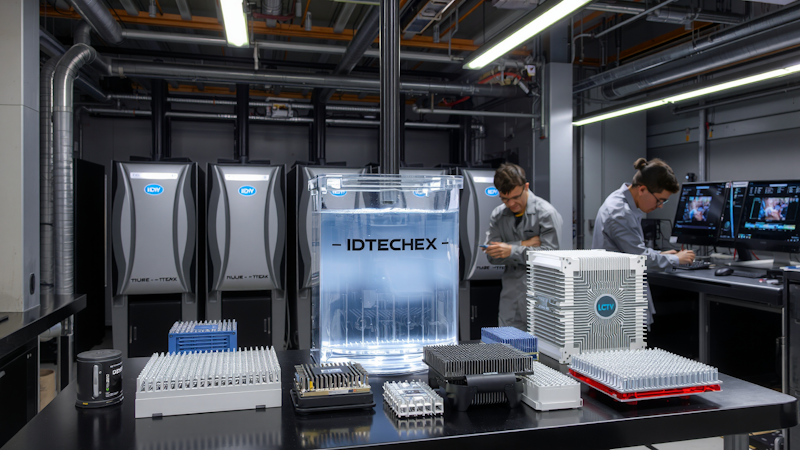
Thermal management technologies are an integral part of systems within a number of sectors, ensuring optimized performance and safety, with data centers and semiconductors being areas to watch as computing becomes increasingly advanced. IDTechEx's portfolio of Thermal Management Research Reports is home to the latest research into thermal management with development and uptake forecasts spanning the next decade.
Liquid cooling, immersion, and hybrid methods for room level
Data centers and the advanced semiconductor packaging sector are becoming increasingly prevalent, as the demand for high-speed data processing grows exponentially. The rise of large language models and artificial intelligence are large drivers for these industries, thus creating a large increase in the need for thermal management technologies to allow them to work successfully.
As hotspots for energy intensive processes that require high computing power, data centers require effective thermal management for the heat that is inevitably generated as a result. IDTechEx's report, "Thermal Management for Data Centers 2026-2036: Technologies, Markets, and Opportunities", explores direct approaches including direct liquid cooling and immersion, and room and facility level cooling.
Liquid cooling requires the installation of a cold plate directly on top of a GPU, CPU, or other component. Direct-to-chip cooling (also known as cold plate cooling) has been one of the most incumbent and favored approaches to data center thermal management over the past two years. Liquid cooling can be deployed as either a single-phase or two-phase approach with two-phase enabling higher cooling power (depending on flow rate).
Immersion cooling is a more direct approach to data center cooling, as like the name would suggest, an entire server board is immersed into a tank of fluid to prevent overheating and to maintain optimum temperatures for working. At room and facility level, cooling is equally as necessary, with hybrid liquid and air methods being deployed to produce the best result. Rear door heat exchangers, computer room air conditioning, computer room air handlers, and sidecar heat exchangers, are all methods outlined within IDTechEx's report as being amongst the most commonly used.
Semiconductors and 3D packaging requirements
Thermal management for semiconductors takes place on a much smaller scale, the developments of which are vital in line with advancing semiconductor technologies and packaging. Thermal interface materials (TIMs) are required to transfer heat from its source, to a heatsink where it can be dissipated. IDTechEx reports that as packaging moves from 2.5D to 3D, these materials will need to prove low thermal resistance.
Thermal conductivity, mechanical reliability, cost, contact quality, ease of testing, and high-volume manufacturing capability, will all be factors for consideration when choosing TIMs, meaning a trade-off between performance and cost is always likely to occur. For example, liquid metals, despite offering low thermal resistance that is desirable, are an expensive option. Other options currently available include solid metals, graphene sheets, and polymer-based TIMs, with new TIMs also being explored.
Thermal gels, indium foil, and copper nanotube-based TIMs, are some emerging material choices, each with their own benefits and drawbacks, with varying qualities including ease of integration, thermal conductivity, and mechanical compliance. These are covered in depth in IDTechEx's report, "Thermal Interface Materials 2026-2036: Technologies, Markets and Forecasts".
3D packaging will, however, also bring about a need for active liquid cooling such as microfluidic cooling. This method is used in defense and military chip applications currently and will likely become more widely commercialized in the future once it becomes more feasible to deploy. Within high performance computing, air cooling, cold plate cooling, immersion cooling, and remote cooling are also emerging options for thermal management. The report, "Thermal Management for Advanced Semiconductor Packaging 2026-2036: Technologies, Markets, and Opportunities", provides the latest insights into the sector.
For more information, visit IDTechEx's portfolio of Thermal Management Research Reports for information on thermal management developments across a wide range of industries.
