

Bioplastics manufacturers are rapidly scaling up production worldwide. A number of major bioplastics capacity expansions have recently been announced, driven by volatile petrochemical prices and legislative bans on fossil-based single-use plastics. In this article, IDTechEx explores the key drivers of the bioplastic industry's ongoing growth.
The bioplastics industry enters its growth phase
Worldwide demand for plastic continues to grow, with the OECD estimating that global plastic consumption will likely double by 2050. However, at present over 99% of plastics are derived from non-renewable fossil fuels which have experienced significant price fluctuations following recent geopolitical volatility.
Notably, a spike in the price of Brent Crude to over US$100/barrel following the closure of the Strait of Hormuz (which ordinarily facilitates approximately 25% of global oil exports) has had a significant downstream impact on petrochemical feedstock prices, providing an added economic incentive for the development of bio-based plastics. The new IDTechEx report "Bioplastics 2026-2036: Technology, Market, Players, and Forecasts" details how the market for bio-based plastics is set to grow rapidly at a CAGR of 13.5% in response to the current economic climate, with production forecasted to reach 14.5 million tonnes per annum by 2036.
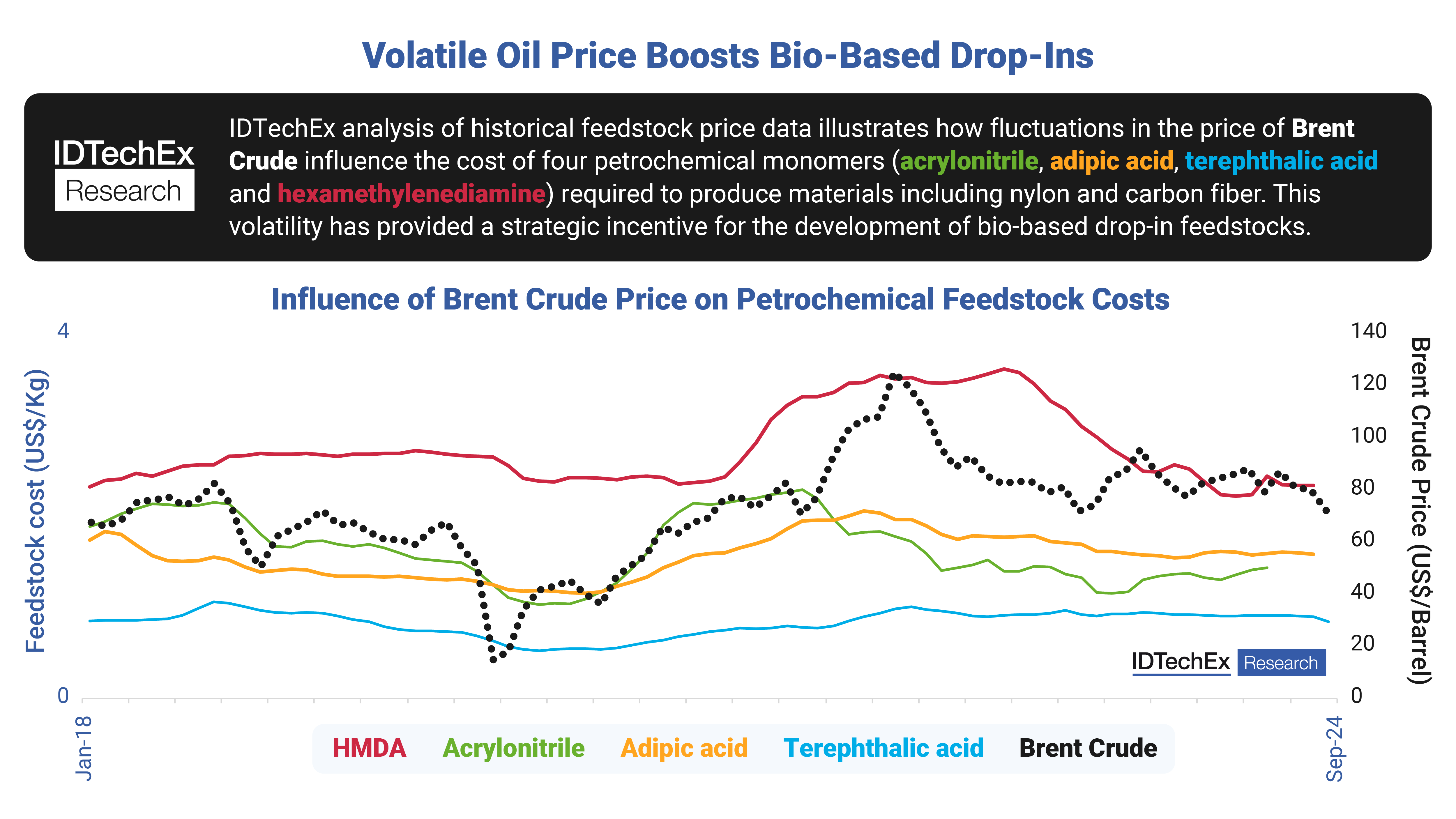
IDTechEx analysis reveals how the sensitivity of petrochemicals to oil price volatility has provided an economic incentive for alternative bio-based drop-ins.
Drop-in bioplastics disrupt industry
Bioplastics that act as direct "drop-ins" for incumbent fossil-based plastics act as a significant industry disruptor. These drop-in bioplastics are derived from bio-based feedstocks that are chemically identical to incumbent petrochemicals and can therefore be either partially or fully substituted for the bio-based form. A notable example is provided by bio-based polyolefins, with IDTechEx research showing that bio-based polyethylene (Bio-PE) and polypropylene (Bio-PP) hold a combined bioplastics market share of 28% in 2026. There is significant demand for drop-in bioplastics from manufacturers as these retain the same desirable material properties as their fossil counterparts and do not require investment in new production and processing infrastructure.
While drop-in bioplastics face the same end-of-life challenges as their fossil-based equivalents, their circularity is enhanced through a combination of renewable sourcing and compatibility with well-established recycling streams. Overall, the plastics market will more readily adopt drop-in bioplastics as they provide a more sustainable means of maintaining the production of well-established commercial plastics, while improving the plastic industry's resilience towards volatile petrochemical feedstock prices. IDTechEx provides detailed coverage of the key players that are developing emerging drop-in solutions, including precursors for bio-based carbon fiber and feedstocks for nylon textiles.
Aggressive expansion by PLA players
Growth drivers are key to compostable bioplastics such as polylactic acid (PLA) establishing a greater market share. These alternative bioplastics do not act as direct drop-ins and therefore require significant expansions in production capacity to compete with incumbent fossil plastics. Consequently, legislative interventions have proven necessary to overcome the green premium faced by these bioplastics.
For example, compostable plastics have been exempted from single-use plastic bans recently introduced in the EU, Middle East and China. The surplus demand for compostable bioplastics provided by these legislative drivers has underpinned a number of large recent PLA capacity expansions by major players including NatureWorks, Futerro and Emirates Biotech. IDTechEx forecasts reflect the continued growth of the PLA market, revealing that worldwide PLA production will surpass 4 million tonnes per annum by 2036.
IDTechEx 2026-2036 bioplastic market forecast
The IDTechEx report "Bioplastics 2026-2036: Technology, Market, Players, and Forecasts" provides detailed coverage and analysis of the key emerging technologies, global trends and growth opportunities that are driving the bioplastics industry. The report segments the bioplastic market into a range of synthetic and natural bioplastic types, with granular 10-year market forecasts provided in each case along with key conclusions regarding technology readiness levels, market disruption potential and future growth drivers. For more information on this report, including downloadable sample pages, please visit www.IDTechEx.com/Bioplastics.
IDTechEx guides your strategic business decisions through its Research, Subscription and Consultancy products, helping you profit from emerging technologies. For more information, contact research@IDTechEx.com or visit www.IDTechEx.com.
