

The humanoid robotics industry is transitioning from prototype development and demonstrations toward structured pilot deployments and early commercial adoption. While actual deployment volumes remain below earlier ambitious targets to date with challenges around training, safety and certification, and mass production, IDTechEx expects 2026-2027 to represent key transition years, with more players moving from pilot testing toward production readiness and early-scale rollout.
Materials such as metal alloys, rare-earth permanent magnets, engineering plastics and composites underpin the critical components of humanoid robots. With a 47% CAGR for humanoid unit sales expected over the next decade, opportunities for industry players, including materials manufacturers and component suppliers to form partnerships with humanoid OEMs and enter the supply chain are emerging, as found in the new IDTechEx market report "Materials for Humanoid Robots 2026-2036: Technologies, Players, Forecasts".
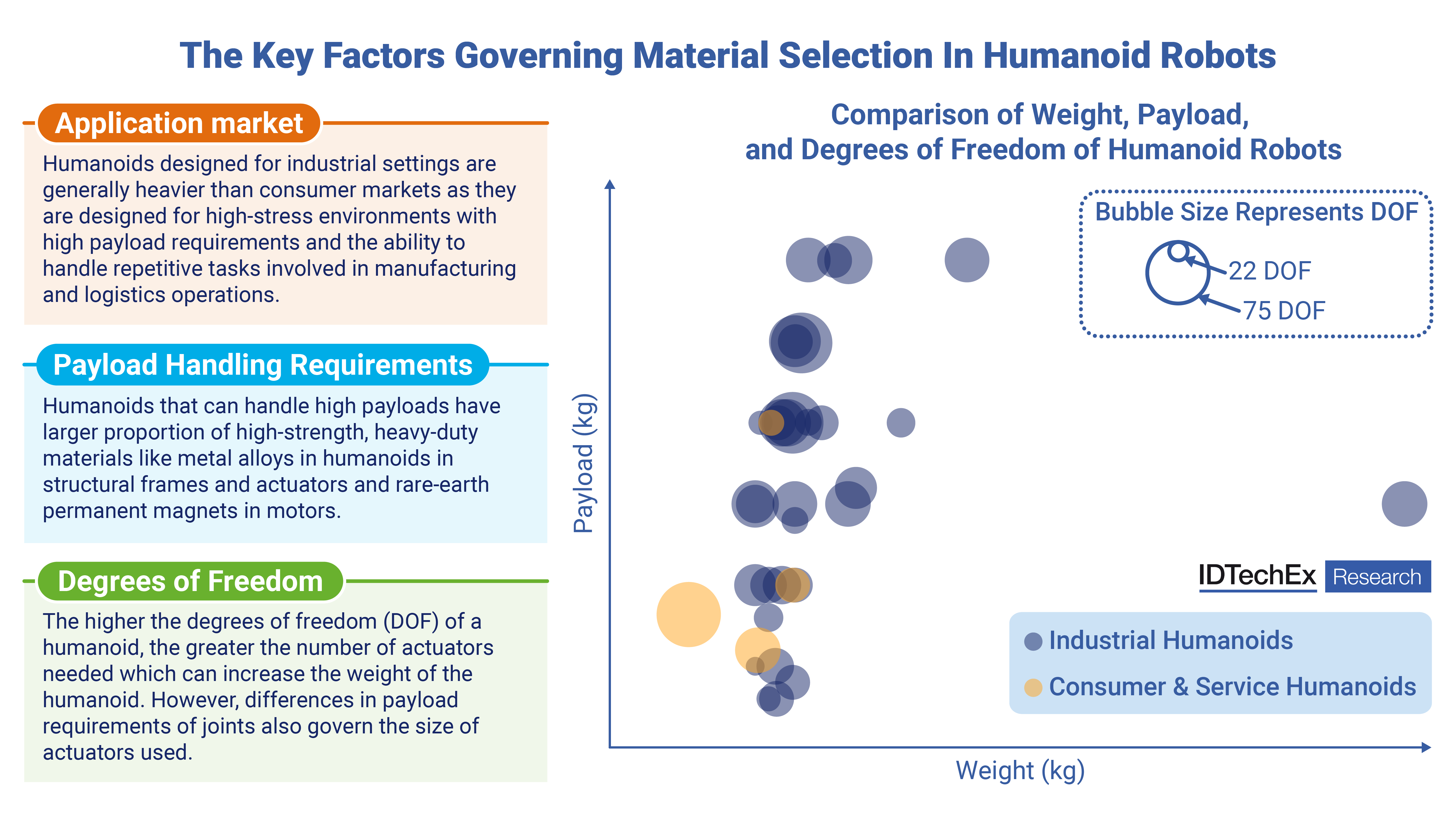
Overview of the key factors governing material selection in humanoid robots. Source: IDTechEx
Hardware for humanoid robots is being optimized for commercial deployment and supply
Humanoid platforms are increasingly converging on shared architectural elements, including electrically actuated joints, integrated sensing, and modular subsystems. While performance and cost remain far from mass-market readiness, development priorities have clearly shifted toward manufacturability, maintainability, and deployment feasibility rather than purely research-oriented designs.
Early deployments remain focused on manufacturing, factories, warehouses, and other structured environments, where labor constraints and repetitive tasks offer clearer near-term value. These demand high reliability, strength, and robustness from actuators, structural frames, and structural protection materials.
Consequently, humanoid components are critically reliant on high-strength metal alloys, rare-earth permanent magnets for high torque motors, composites and engineering plastics for their lightweight yet strong mechanical properties, and materials for protection and cushioning. Through detailed analysis of over 50 humanoid products and prototypes, and consideration of factors such as actuator types and torque requirements by joint position, IDTechEx's "Materials for Humanoid Robots 2026-2036: Technologies, Players, Forecasts" report provides insights into the material breakdown for humanoid components and critically compares competing materials across several technical parameters.
Opportunities for Materials and Component Players
The supply chain for components specific to humanoid robots is still evolving and will need to be optimized as the market matures. In this rapidly evolving space, while some humanoid OEMs have taken the approach of vertical integration, many are forming partnerships with component suppliers. For instance, actuator suppliers that traditionally supply to the automotive industry are diversifying to meet the needs of humanoids market.
IDTechEx's report explores the supply chains for materials and components, as well as the regional opportunities in the humanoids market. As an example, rare-earth permanent magnets (e.g. NdFeB) offer outstanding magnetic strength and performance-per-weight attributes to provide the torque density required for humanoid actuator motors. However, rare-earth magnet supply chains are heavily consolidated in China, which is also fueling the growth of alternative supply chains across the US, Europe, and Asia, in a move to derisk supply.
As the humanoid robotics market expands and technological advances continue, there is significant potential for lightweighting to not just improve locomotion but also extend battery life. To facilitate this, materials innovations will be a key cornerstone in underpinning the development of next-generation humanoid hardware. "Materials for Humanoid Robots 2026-2036: Technologies, Players, Forecasts" provides an extensive analysis of advances in materials, offering a thorough overview of emerging alternative materials for humanoid components.
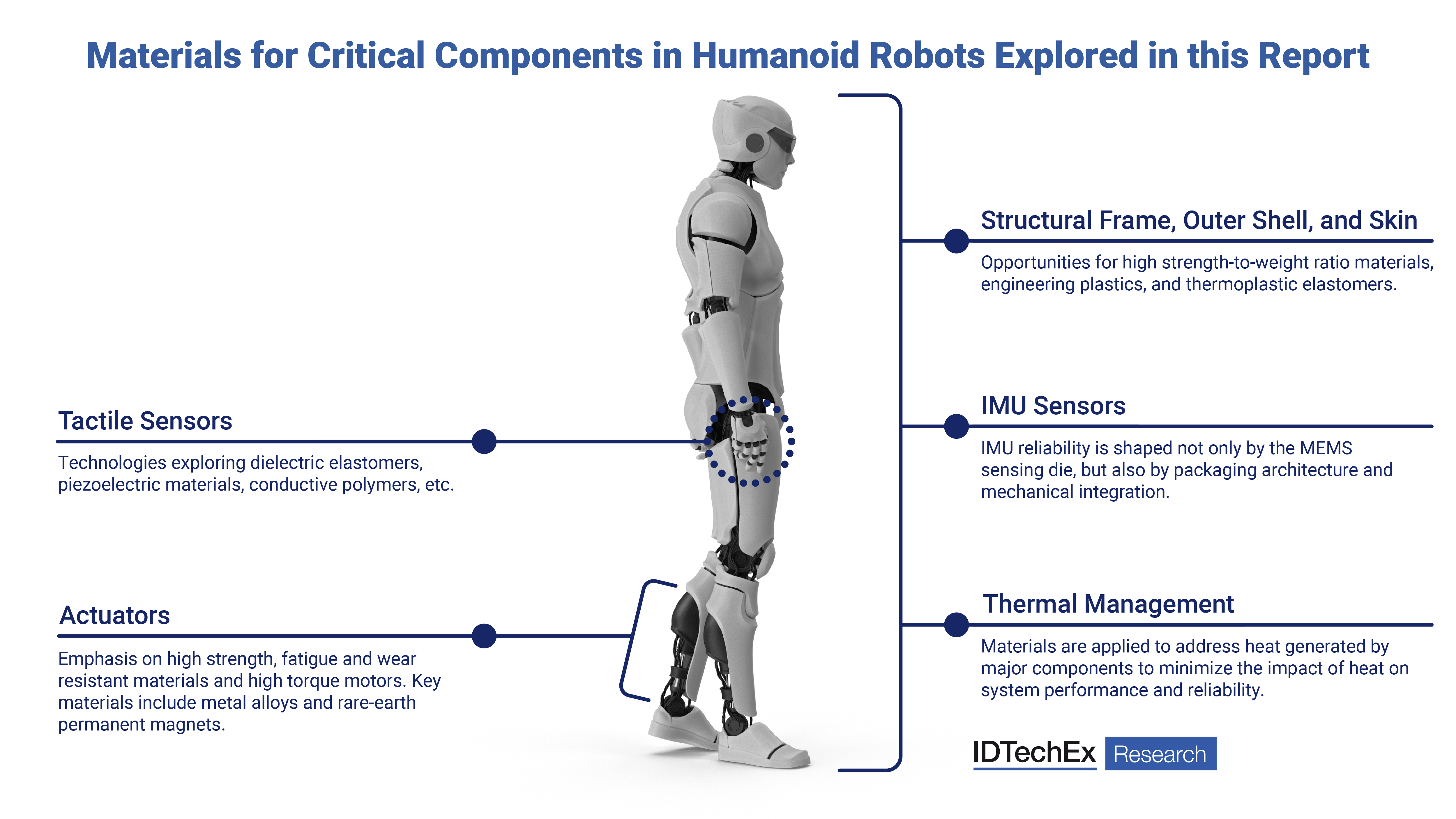
Materials and critical components in humanoid robots explored in this report. Source: IDTechEx
At this pivotal stage for the humanoid robotics market, IDTechEx's report "Materials for Humanoid Robots 2026-2036: Technologies, Players, Forecasts" delivers essential market insights and trends, highlighting key emerging opportunities for materials and component suppliers. The report offers an in-depth analysis of material requirements and roadmaps, challenges and bottlenecks, overview of supply chains and industry players for the major components in humanoid robots, including actuators, structural elements (frames, shells & panels, and skin), thermal management, and tactile sensors. The report also provides 10-year demand forecasts segmented by material type, including metal alloys (steel, aluminum & magnesium), rare-earth permanent magnets, engineering plastics (e.g PEEK, PC-ABS), and more.
For more information on this report, including downloadable sample pages, please visit www.IDTechEx.com/MatsForHumanoids. IDTechEx also offers further related reports on technologies, markets and opportunities for humanoid robots (www.IDTechEx.com/HumanoidRobots) and rare earth magnets (www.IDTechEx.com/REM). For the full portfolio of research available from IDTechEx, see www.IDTechEx.com.
